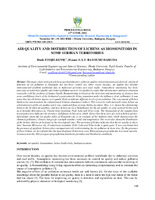
Air quality and distribution of Lichens as biomonitors in some Serbian territories
Stojilkovic, Doris
Bayoumi Hamuda, Hosam E.A.F.
Bayoumi Hamuda, Prof. Dr. Hosam
2026-08-12T11:53:22Z
2026-08-12T11:53:22Z
2021
http://hdl.handle.net/20.500.14044/40071
This paper deals with using lichens as a bioindicators of the air quality. A bioindication and physical- chemical
detection of air pollution in Zrenjanin has not been carried out. Over recent decades, air quality has become
environmental problem worldwide due to industrial activities and road traffic. Atmospheric monitoring has been
necessary to control air quality and reduce pollution sources. Air quality is a topic that attracts more and more attention
especially with the problem of human health. Biomonitoring is based on the detection and monitoring of changes that
occur on different levels of the biological organization for living organisms under the influence of air pollutants. It was
noted that not all lichen species are equally likely to indicate different levels of air pollution. The assessment of lichen
biodiversity was based on the calculation of lichenic abundance indices. This research work deals with using lichens as
a bioindicators of the air quality and it was conducted from various Serbia locations. Also, it is shown the relationship
between the Serbian air qualities, and how lichens act as a bioindicator for the air quality, in some parts of Serbia such
as in Sremska Mitrovica city, Fruska Gora mountine, Palic Lake and Silver Lake. The bioanalysis of the samples from
investigated sites indicates the presence of different lichen taxa, which shows that these sites are rich in lichen species.
Information about the air quality index of Zrenjanin city as an example of the Serbian cities which demonstrates the
chemical pollutants, climate changes for example weather, wind and temperature This work also shows the distribution
of the lichens which can be found in the investigated sites. The presence of lichen indicates that the air quality in these
sites: Sremska Mitrovica city, Fruska Gora mountine, Palic Lake and Silver Lake is quite good. It was concluded that
the presence of epiphytic lichens plays an important role in determining the air pollution in those sites. By the presence
of these lichens, we have found that the most dominant lichen taxa were Rhizocarpon geographicum, Lecanora muralis,
Lecanora muralis, Rhizocarpon geographicum, Xanthoria parietina and Xanthoria candelaria.
hu_HU
dc.format
pdf
hu_HU
en
hu_HU
Air quality and distribution of Lichens as biomonitors in some Serbian territories
hu_HU
Open access
hu_HU
Óbudai Egyetem
hu_HU
2021. November 18-19.
hu_HU
Budapest
hu_HU
Rejtő Sándor Könnyűipari és Környezetmérnöki Kar
hu_HU
Óbudai Egyetem
hu_HU
Természettudományok - környezettudományok
hu_HU
air quality
hu_HU
biomonitors
hu_HU
lichen biodiversity
hu_HU
serbian locations
hu_HU
Konferenciaközlemény
hu_HU
Proceedings Book (Part A) 12th ICEEE-2021 International Annual Conference
hu_HU
local.tempfieldCollections
Könyvrészletek
hu_HU
41.
hu_HU
Kiadói változat
hu_HU
14 p.
hu_HU
Global Environmental Development & Sustainability: Research, Engineering & Management