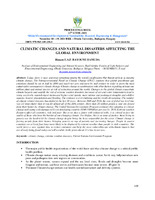
Climatic changes and natural disasters affecting the global environment
Bayoumi Hamuda, Hosam E.A.F.
Bayoumi Hamuda, Prof. Dr. Hosam
2026-08-12T08:56:41Z
2026-08-12T08:56:41Z
2021
http://hdl.handle.net/20.500.14044/40059
Today, there is near universal consensus among the world’s professions that human activity is causing
climate change. The Intergovernmental Panel on Climate Change (IPCC) cautions that global greenhouse gas
emissions should be cut in half by 2030 and reach net zero emissions by mid-century in order to avert the most
catastrophic consequences climate change. Climate change in combination with other factors is putting at least one
million plant and animal species at risk of extinction around the world. Changes in the global climate exacerbate
climate hazards and amplify the risk of extreme weather disasters. Increases of air and water temperatures lead to
rising sea levels, supercharged storms and higher wind speeds, more intense and prolonged droughts and wildfire
seasons, heavier precipitation and flooding. The evidence is overwhelming and the results devastating: The number
of climate-related disasters has tripled in the last 30 years. Between 2006 and 2016, the rate of global sea-level rise
was 2.5 times faster than it was for almost all of the 20th century. More than 20 million people a year are forced
from their homes by climate change. The United Nations Environment Program estimates that adapting to climate
change and coping with damages will cost developing countries $140-300 billion per year by 2030. Extreme weather
disasters affect all countries, rich and poor. But as we face a future with enhanced risks, it is critical to face the
reality of those who bear the burden of our changing climate. For Oxfam, this is an issue of justice: those living in
poverty are the hardest hit by climate change despite being the least responsible for the crisis. Climate change is
forcing people from their homes, bringing poverty on top of poverty and increasing hunger. People in poorer
countries are at least four times more likely to be displaced by extreme weather than people in rich countries. The
world faces a race against time to reduce emissions and help the most vulnerable cope with climate impacts that
are already being faced today and will escalate in the years ahead. It’s time to act now.
hu_HU
dc.format
pdf
hu_HU
en
hu_HU
Climatic changes and natural disasters affecting the global environment
hu_HU
Open access
hu_HU
Óbudai Egyetem
hu_HU
2021. November 18-19.
hu_HU
Budapest
hu_HU
Rejtő Sándor Könnyűipari és Környezetmérnöki Kar
hu_HU
Óbudai Egyetem
hu_HU
Természettudományok - környezettudományok
hu_HU
climate change
hu_HU
extreme weather disasters
hu_HU
united nations environment program
hu_HU
Konferenciaközlemény
hu_HU
Proceedings Book (Part A) 12th ICEEE-2021 International Annual Conference
hu_HU
local.tempfieldCollections
Könyvrészletek
hu_HU
39.
hu_HU
Kiadói változat
hu_HU
8 p.
hu_HU
Global Environmental Development & Sustainability: Research, Engineering & Management