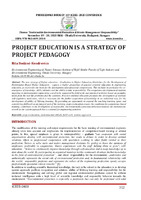
Project education is a strategy of project pedagogy
Bodáné-Kendrovics, Rita
E.A.F. Bayoumi Hamuda, Prof. Dr. Hosam
2026-05-18T11:12:46Z
2026-05-18T11:12:46Z
2020
http://hdl.handle.net/20.500.14044/38537
The new strategy of higher education - Graduation in Higher Education, Guidelines for the Development of
Performance-Based Higher Education - expects a higher proportion of practice-oriented education in engineering
education, as it provides the basis for the development of professional competencies. This includes in particular the co-
emergence of knowledge, skills, attitudes and the ability to take responsibility. The competency development of students
majoring in environmental engineering s need to be supported by field work and practical activities based on examples
taken from the real life problems and the solutions. Practice-oriented education promotes the development of internal,
self-regulatory motivation, which is necessary for the further acquisition of knowledge in an individual way, for the
development of ability of lifelong learning. By providing an opportunity to expand the teaching-learning space and
considering fieldwork as an integral part of the training, project education creates the conditions for competence-based
training, contributes to the development of responsible, environmentally conscious behaviour towards the environment,
as well as the system approach that is essential for engineering activities.
hu_HU
dc.format
pdf
hu_HU
en
hu_HU
Project education is a strategy of project pedagogy
hu_HU
Open access
hu_HU
Óbudai Egyetem
hu_HU
2020. November 19-20.
hu_HU
Budapest
hu_HU
Rejtő Sándor Könnyűipari és Környezetmérnöki Kar
hu_HU
Óbudai Egyetem
hu_HU
Bölcsészettudományok - neveléstudományok
hu_HU
project education
hu_HU
environmental attitude
hu_HU
field work
hu_HU
systems approach
hu_HU
Konferenciaközlemény
hu_HU
Proceedings Book of 11th ICEEE-2020 International Annual Conference