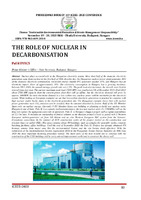
Nuclear plays a crucial role in the Hungarian electricity system. More than half of the domestic electricity generation came from nuclear in the first half of 2020. Besides this, the Hungarian nuclear power plant generates 36% of the domestic electricity consumption, renewable energy (mainly PV) generates another 11%, and Hungary has an electricity import share of approximately 30%. The electricity consumption in Hungary has a growing tendency, between 2013-2019, the annual average growth rate was 1,3%. The peak load also increases, the records were broken several times last year. The current maximum peak load (7105 MW) was reached on 5th of December 2019. Until 2033 about 2500 MW capacity from the current power plant fleet will go offline, but the electricity demand will grow by approx. 1000MW. To meet electricity demand in a low carbon way, nuclear power will be inevitable for the electricity system. When looking at European examples we see that low-carbon electricity generation is reached in countries with high nuclear and/or hydro share in the electricity-generation mix. The Hungarian example shows that with nuclear power generation more CO2 emission can be avoided, than the amount absorbed by forests. Half of the EU Member States rely on nuclear energy. Currently 9 EU Member States are building or planning to build new nuclear units. Hungary is one of them. Paks II. is a capacity replacement project, the two new nuclear units (2x 1200MWe) will on the long run replace the aging units currently in operation. Paks II. is Hungary’s biggest project with a capital expenditure of 12,5 bn euro. It includes an outstanding technical solution as the Russian primary circuit is paired with a Western European turbine-generator set from GE-Alstom and an also Western European I&C system from the SiemensFramatome consortium. In the summer of 2019 construction works of the project started on the construction and erection base (so called CEB). This area contains about 80 buildings, such as complex for assembly works, concrete batching facilities, office buildings. Until the end of September 2020 the Paks II. Project has already obtained 478 licenses, among them major ones like the environmental license and the site license (both effective). With the submission of the Implementation License Application (ILA) to the Hungarian Atomic Energy Authority on 30th June 2020 the most important licensing procedure started. The main tasks of the next months are to continue with the construction of the CEB buildings and to carry out soil improvement works and to construct the slurry wall.
hu_HU
dc.format
pdf
hu_HU
en
hu_HU
The role of nuclear in decarbonisation
hu_HU
Open access
hu_HU
Óbudai Egyetem
hu_HU
2020. November 19-20.
hu_HU
Budapest
hu_HU
Rejtő Sándor Könnyűipari és Környezetmérnöki Kar
hu_HU
Óbudai Egyetem
hu_HU
Műszaki tudományok - bio-, környezet- és vegyészmérnöki tudományok
hu_HU
nuclear power plant
hu_HU
nuclear energy
hu_HU
nuclar power generation
hu_HU
renewable energy
hu_HU
Konferenciaközlemény
hu_HU
Proceedings Book of 11th ICEEE-2020 International Annual Conference